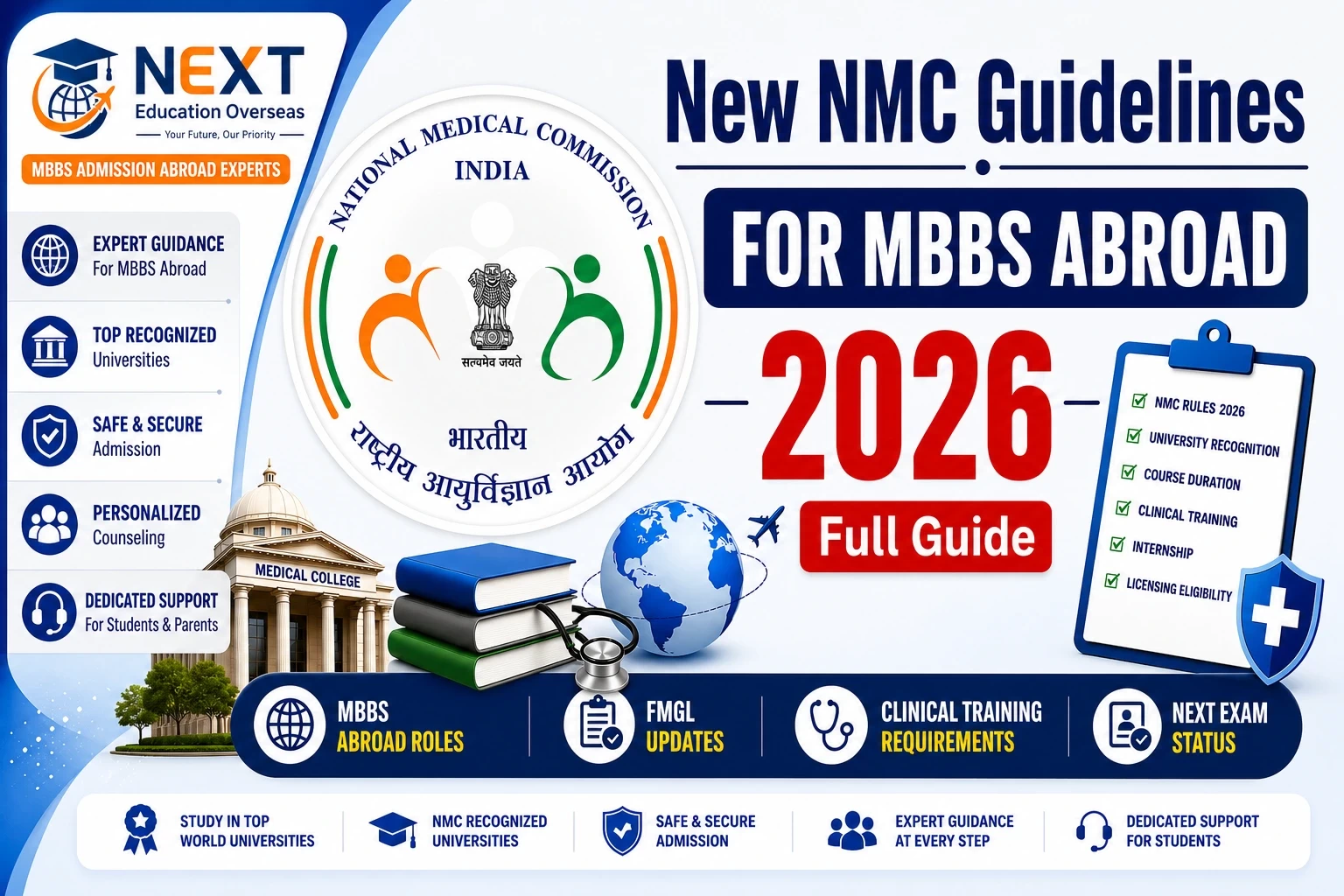
NMC Rules for MBBS Abroad 2026: Complete Guide for Indian Students
Pursuing an MBBS degree abroad has become a popular option for Indian students who want quality medical education at an affordable cost. However, choosing the right university is more important than choosing the country itself. If your medical university does not meet the National Medical Commission (NMC) regulations, your degree may not be valid for medical practice in India.
The National Medical Commission (NMC) has introduced regulations to ensure that Indian students pursuing MBBS abroad receive medical education equivalent to the MBBS curriculum in India. Following these guidelines is essential for students who plan to return to India for medical registration and practice. The applicable framework remains the Foreign Medical Graduate Licentiate (FMGL) Regulations, 2021, along with subsequent NMC advisories
This guide explains the latest NMC rules for MBBS abroad in 2026, eligibility requirements, internship regulations, licensing exams, and the important factors every student should verify before taking admission.
Why Are NMC Rules Important?
NMC Eligibility for MBBS Abroad
Before applying to any foreign medical university, students should ensure they meet the basic eligibility conditions.
NEET Qualification
Indian students must qualify the NEET-UG examination before taking admission abroad. A qualifying score is mandatory for future registration in India.
Educational Qualification
Students applying for MBBS abroad should meet the basic academic eligibility requirements set by the university and applicable NMC guidelines.
- 10+2 Qualification – Must have passed Class 12 or an equivalent examination from a recognized board.
- Required Subjects – Physics, Chemistry, Biology/Biotechnology, and English must be studied in Class 12.
- Minimum Marks – Meet the minimum percentage required by the chosen university and NMC eligibility criteria.
- NEET Qualification – Indian students must qualify NEET to be eligible for MBBS abroad and to pursue medical registration in India.
- Valid Documents – Keep original mark sheets, passing certificates, passport, and other academic documents ready during admission.
Most universities require at least 50% marks in Physics, Chemistry, and Biology for general category students, while reserved categories may receive relaxation according to prevailing guidelines.
Common Mistakes Students Make — and How to Avoid Them
- Choosing an Unrecognized University – Always verify the university's recognition before taking admission.
- Ignoring NMC Guidelines – Ensure the course complies with the latest NMC regulations for FMGs.
- Not Verifying Course Duration – Confirm the MBBS program meets the required duration, including internship.
- Skipping Clinical Training Checks – Choose a university that provides adequate hands-on clinical exposure.
- Paying Fees Without Documentation – Never pay admission fees before receiving official documents and fee details.
- Believing False Promises – Be cautious of agents guaranteeing direct licenses, transfers, or 100% FMGE/NeXT success.
- Ignoring Total Costs – Calculate tuition, hostel, insurance, visa, and living expenses before enrolling.
- Overlooking Language Requirements – Confirm the complete MBBS course is taught in English if required.
- Missing Visa and Admission Deadlines – Submit documents and applications well before the deadlines.
- Not Researching Student Support – Check hostel facilities, safety, academic support, and international student services before making a decision.
What Are the NMC Rules for MBBS Abroad in 2026?
The NMC rules for MBBS abroad are legally binding standards set by India's National Medical Commission under the Foreign Medical Graduate Licentiate Regulations, 2021. These rules decide whether a foreign medical degree is recognised in India — and therefore, whether the graduate can sit for FMGE/NEXT, register with a State Medical Council, and practice medicine.
The intent is simple: every Indian-origin doctor trained abroad must match the academic depth and clinical exposure of an MBBS graduate from an Indian medical college. Here's the full snapshot of what the rules cover in 2026:
|
NMC Rule |
2026 Requirement |
|
Course Duration |
Minimum 54 months of academic study (4.5 years) |
|
Internship Duration |
12 months at the same foreign university |
|
Medium of Instruction |
Entirely in English — no bilingual or partial-English programs |
|
Single-Institution Rule |
Entire course + internship at one university, in one country |
|
Clinical Training |
Hands-on, in real hospital settings — online clinical training not accepted |
|
NEET Qualification |
Mandatory for Indian students before admission |
|
Licensing Exam |
FMGE (currently) or NEXT (when implemented) — mandatory pass |
|
India Internship (CRMI) |
12-month Compulsory Rotating Medical Internship after FMGE/NEXT |
|
Applicability |
All Indian students admitted abroad on or after 18 November 2021 |
Minimum Course Duration
One of the most important NMC requirements relates to the duration of medical education.A recognized foreign medical program should include:
|
Course Structure |
NMC Compliance |
|
5-year academic + 1-year internship at same university |
✓ Compliant |
|
4.5-year academic + 1-year internship at same university |
✓ Compliant (minimum) |
|
4-year accelerated MBBS / MD program |
✗ Not Compliant |
|
Academic + internship split across two universities |
✗ Not Compliant |
|
Course completed in less than 54 months due to credit transfer |
✗ Not Compliant |
The internship should form part of the medical curriculum and follow the academic program.
Students should avoid universities offering accelerated medical degrees that significantly reduce the academic duration.
Internship Requirements
Practical clinical training is an essential component of medical education.
The internship should:
-
Be completed according to the university's approved curriculum
-
Include clinical rotations in recognized teaching hospitals
-
Provide direct patient exposure
-
Be completed as required under the university's program
After returning to India and fulfilling licensing requirements, graduates may also need to complete additional internship requirements as prescribed by Indian authorities.
English Medium Requirement
Students should always verify that the complete MBBS course is taught in English.
This includes:
-
Classroom lectures
-
Practical sessions
-
Clinical training
-
Internal examinations
Studying in an English-medium program helps students prepare effectively for licensing examinations in India.
Clinical Training Standards
Medical education is incomplete without practical experience.
A good medical university should provide:
-
Teaching hospitals
-
Regular patient interaction
-
Bedside clinical learning
-
Laboratory training
-
Practical medical procedures
Clinical exposure is one of the most important aspects to verify before admission.
NEET and Licensing Examination
Qualifying NEET allows Indian students to study medicine abroad, but it does not automatically grant permission to practice medicine in India.
After completing MBBS abroad, graduates must fulfill the licensing requirements applicable at that time before obtaining registration to practice medicine.
Students should regularly follow official announcements regarding licensing examinations and registration procedures.
Documents Students Should Verify Before Admission
Documents Students Should Verify Before Admission
Before paying any admission fees, ask the university to provide the following documents:
-
Official Admission Letter – Confirms your admission, course, and enrollment details.
-
Course Duration Details – Verifies the total program length meets NMC requirements.
-
Medium of Instruction Certificate – Confirms the MBBS program is taught in English.
-
Internship Information – Explains internship duration, location, and completion requirements.
-
Clinical Training Details – Provides information on hospital rotations and hands-on clinical exposure.
-
Recognition Documents – Confirms the university is recognized by the relevant education and medical authorities.
-
Tuition Fee Structure – Shows the complete fee breakdown, payment schedule, and any additional charges.
-
Student Handbook – Outlines academic policies, examination rules, attendance, and student regulations.
-
Hostel Information – Includes accommodation facilities, room options, safety, and hostel fees.
-
Academic Calendar – Lists semester dates, examinations, holidays, and important academic deadlines.
FMGE vs NEXT — 2026 Comparison & Latest Status
There has been continuous noise about NEXT replacing FMGE since 2022. As of 2026, FMGE is still the active licensing exam for foreign medical graduates. NEXT implementation has been officially delayed by NMC and is not expected before 2027–2028. Here's how they compare:
|
Parameter |
FMGE (Current) |
NEXT (Future) |
|
Conducting Body |
NBEMS |
NMC (via NBEMS) |
|
Frequency |
Twice a year (June, December) |
Likely twice a year |
|
Format |
Single MCQ paper, 300 questions |
Two-step: NEXT-1 (theory) + NEXT-2 (clinical) |
|
Pass Criterion |
50% aggregate |
To be notified — expected stricter |
|
Applies To |
Foreign medical graduates only |
Both Indian + foreign graduates (unified exam) |
|
Replaces |
N/A |
FMGE + NEET-PG (combined exam) |
|
Difficulty Level |
Moderate |
Expected significantly higher (clinical focus) |
|
Status in 2026 |
Active — June and December sessions confirmed |
Implementation delayed — not expected before 2027 |
FMGE June 2026: The NBE has scheduled the FMGE June 2026 session for 28 June 2026, with applications opening in April 2026. Always verify exam dates directly on natboard.edu.in before planning your post-MBBS timeline.
2026 NMC Compliance Checklist Before Admission
Before you pay any application fee, sign any agreement, or book any travel — run this 10-point compliance audit on your shortlisted university:
3.English medium proof: Ask for the official medium-of-instruction certificate template the university issues to graduates. This is required at FMGE registration.
4.Single-institution confirmation: Confirm that internship will be at the same university — not a partner hospital in a different country or city under a different administration.
5.FMGE pass rate: Check the university's FMGE pass rate for the last 3 years. NBE publishes these stats. Below 20% pass rate = serious red flag.
6.Clinical hospital verification: Confirm the university has its own teaching hospital(s) with adequate patient flow — not just classroom-based education.
7.Recognition by India embassy: Verify that the Indian Embassy in that country has not issued any travel/admission advisory against the university.
8.NEET scorecard validity: Ensure your NEET scorecard for the admission year is valid and qualifying.
9.Country-level political stability: NMC has previously refused FMGE eligibility for students who completed degrees in conflict zones with disrupted clinical training.
10.Written compliance commitment: Get a written, dated letter from the university confirming the program meets NMC 2021 regulations. Keep it as documentary proof.
Best NMC-Compliant Countries for MBBS in 2026
NMC does not maintain a country-wise approved list — it sets compliance criteria, and any university meeting them qualifies. That said, some countries have a higher density of NMC-compliant universities, established Indian student communities, and consistent FMGE pass rates:
|
Country |
Avg. Total Cost (6 yrs) |
Compliance Strength |
|
₹35 – ₹65 Lakhs |
High — many WFME-accredited universities, English-medium, large Indian community |
|
|
₹35 – ₹55 Lakhs |
High — strong English-medium programs, modernised curriculum |
|
|
₹25 – ₹35 Lakhs |
Moderate-High — verify clinical training infrastructure carefully |
|
|
₹25 – ₹45 Lakhs |
Moderate — growing Indian student presence |
|
|
₹25 – ₹35 Lakhs |
Moderate — most affordable, but verify university-level compliance |
|
|
₹35 – ₹55 Lakhs |
High — but BS+MD structure needs careful NMC mapping |
|
|
₹45 – ₹60 Lakhs |
High — historically strong FMGE pass rates |
Students should always evaluate individual universities carefully rather than selecting a destination based solely on the country.
Common Mistakes to Avoid
Many students face difficulties because they:
-
Choose universities without proper verification
-
Depend entirely on education consultants
-
Ignore internship requirements
-
Fail to confirm the course structure
-
Do not check the language of instruction
-
Overlook clinical training facilities
-
Focus only on low tuition fees
Careful research before admission can prevent future complications.
Tips for Students Planning MBBS Abroad in 2026
-
Qualify NEET before applying.
-
Compare multiple universities before making a decision.
-
Read the complete admission brochure carefully.
-
Verify all academic and internship details in writing.
-
Keep copies of every important document.
-
Stay updated with official notifications from Indian medical authorities.
-
Discuss your options with current students or alumni whenever possible.
Final Thoughts
Studying MBBS abroad can be an excellent opportunity for Indian students when the university is chosen carefully. Understanding the latest NMC regulations helps students avoid future registration issues and ensures their medical education supports their long-term career goals.
Rather than selecting a university based only on cost or advertisements, focus on academic quality, clinical training, and compliance with applicable regulations. A well-informed decision today can make the path to becoming a licensed doctor in India much smoother after graduation.