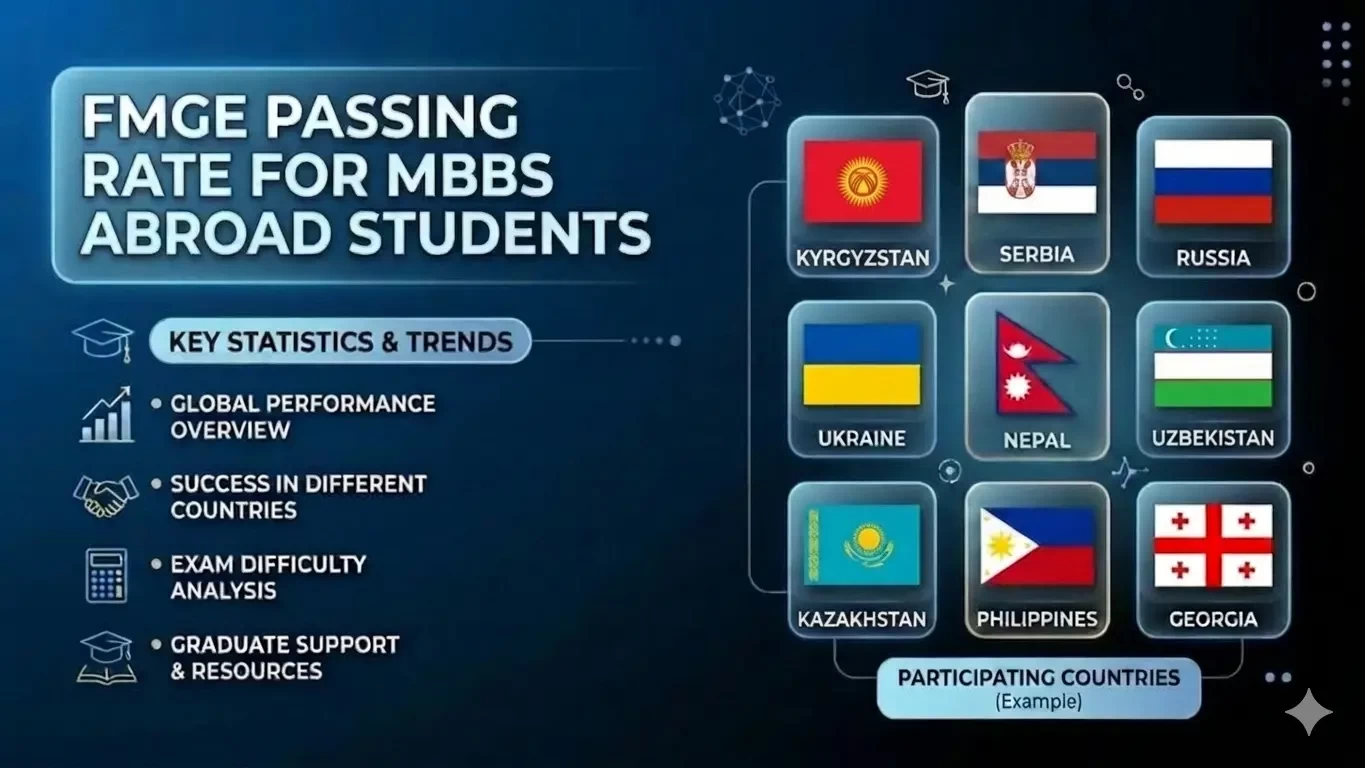
FMGE PASSING RATE COUNTRY WISE FOR MBBS ABROAD STUDENTS
For Indian students planning to study MBBS abroad, the FMGE passing rate country wise is an important factor when comparing medical universities and countries.
The Foreign Medical Graduate Examination (FMGE) is conducted by the National Board of Examinations in Medical Sciences (NBEMS). FMGE performance can vary significantly between examination sessions, universities, graduating batches and individual candidates.
Therefore, an FMGE pass rate should be used as a research indicator, not as a guarantee that students from a particular country or university will pass the examination.
FMGE Pass Rate 2026: Latest Update
The FMGE June 2026 result was declared by NBEMS on July 7, 2026. The June 2026 session had 4,635 qualified candidates, while the overall pass percentage was reported at around 12.4%–12.8%, depending on the denominator used in different published summaries.
The important point for students is that the overall FMGE pass percentage represents the performance of the entire examination cohort. It should not be interpreted as the passing percentage of every foreign medical university or country.
NBEMS continues to publish FMGE results and institute-wise/country-wise performance information through its official examination resources.
What Is the FMGE Passing Rate?
The FMGE passing rate is the percentage of candidates who qualify the Foreign Medical Graduate Examination in a particular examination session.FMGE is a qualifying examination. A student's result depends on whether the candidate achieves the prescribed qualifying score and satisfies the applicable eligibility requirements.The pass percentage can change from one session to another because the candidate pool, number of repeat candidates, preparation levels and individual performance also change.For this reason, an old FMGE pass percentage should never be presented as a guaranteed future result.
FMGE Passing Rate Country Wise
Students frequently search for:
- FMGE passing rate country wise
- FMGE pass rate
- FMG pass percentage
- FMGE passing percentage
- FMGE pass rate in Russia
- FMGE pass rate in Uzbekistan
- FMGE passing percentage in Philippines
- FMGE pass rate in Kazakhstan
- FMGE pass rate in Kyrgyzstan
- FMGE pass rate in Georgia
The most reliable approach is to check official NBEMS performance information and, wherever available, examine the performance of the specific university rather than relying only on a country-level percentage.
Latest Detailed Country-Wise FMGE Data
The following figures are from the NBEMS FMGE December 2025 Performance Report. They are included as a recent official country-wise reference and should not be treated as permanent 2026 country averages.
|
Primary Medical Qualification Country |
Candidates Appeared |
Candidates Passed |
Pass Percentage |
|
Uzbekistan |
976 |
394 |
40.37% |
|
Georgia |
2,899 |
938 |
32.36% |
|
Russian Federation |
6,878 |
2,128 |
30.94% |
|
Kazakhstan |
3,655 |
1,072 |
29.33% |
|
Kyrgyzstan |
7,437 |
1,503 |
20.21% |
|
Philippines |
4,864 |
903 |
18.56% |
|
China |
6,537 |
932 |
14.26% |
|
Nepal |
953 |
228 |
23.92% |
|
Bangladesh |
2,038 |
702 |
34.45% |
|
Ukraine |
2,970 |
638 |
21.48% |
Source: NBEMS FMGE Performance Report – December 2025.
These figures show why students should be careful with statements such as “this country has a 100% FMGE pass rate” or “students from this country always pass FMGE.” Examination performance changes between sessions and universities.
FMGE Passing Percentage in Philippines
The Philippines FMGE passing percentage is a frequently searched topic among Indian students considering medical education in the Philippines.According to the NBEMS December 2025 country-wise performance report, candidates whose primary medical qualification country was listed as Philippines had:
- 4,864 candidates
- 903 candidates passed
- 18.56% pass percentage
This figure is for the December 2025 FMGE session and should not be presented as the permanent FMGE passing rate of the Philippines.A student's outcome can depend on the specific medical school, curriculum, clinical exposure, preparation and individual performance.
Should You Choose Philippines Only Because of FMGE Results?
No.Students considering MBBS in the Philippines should evaluate:
- Medical university and its current status
- Curriculum and academic structure
- Clinical exposure
- Hospital training
- Course duration
- Medium of instruction
- Total tuition and living expenses
- Applicable Indian regulatory requirements
- Latest available FMGE performance information
A country-level percentage alone is not sufficient to select a medical university.
FMGE Pass Rate in Russia
Russia is one of the major destinations for Indian students pursuing medical education abroad.In the NBEMS December 2025 country-wise report, candidates with their primary medical qualification listed as Russian Federation recorded:
- 6,878 candidates
- 2,128 candidates passed
- 30.94% pass percentage
This does not mean that every Russian medical university has a 30.94% FMGE pass rate.The result is a country-level figure for that particular FMGE session. Students should investigate the specific university they are considering.Before taking admission, compare the university's curriculum, clinical training, teaching hospitals, academic support and available FMGE performance information.
FMGE Pass Rate in Uzbekistan
Uzbekistan has become a popular option among Indian students looking for affordable medical education abroad.The NBEMS December 2025 country-wise performance report recorded:
- 976 candidates
- 394 candidates passed
- 40.37% pass percentage
This was the highest pass percentage among the listed major destinations in that particular report.However, students should not interpret this as a guarantee that an individual university or future batch will achieve the same result.
The performance should be considered together with university quality, clinical exposure, curriculum and Indian regulatory requirements.
FMGE Pass Rate in Kazakhstan
According to the NBEMS December 2025 country-wise performance report:
- 3,655 candidates
- 1,072 candidates passed
- 29.33% pass percentage
The figure represents the performance of candidates whose primary medical qualification country was Kazakhstan during that session.Students interested in MBBS in Kazakhstan should research the individual university instead of using the country-level number as a prediction.
FMGE Pass Rate in Kyrgyzstan
Kyrgyzstan is another destination frequently considered by Indian MBBS abroad aspirants.
The NBEMS December 2025 report recorded:
- 7,437 candidates
- 1,503 candidates passed
- 20.21% pass percentage
The number is session-specific and does not represent the guaranteed future performance of students studying in Kyrgyzstan.Students should compare individual universities, clinical exposure, teaching hospitals, academic support and the latest available FMGE data.
FMGE Pass Rate in Georgia
For Georgia, the NBEMS December 2025 performance report recorded:
- 2,899 candidates
- 938 candidates passed
- 32.36% pass percentage
Georgia has several medical universities, so students should not assume that the country-level figure applies equally to every institution.When comparing universities, look at curriculum, clinical training, hospital exposure, academic support and the university's available historical FMGE performance.
FMGE Pass Rate in Serbia
Serbia is also considered by Indian students seeking medical education in Europe.However, country-wise FMGE data should be interpreted carefully because the number of candidates from a country can vary considerably between sessions.
Students considering MBBS in Serbia should evaluate the individual university, curriculum, clinical exposure, teaching hospitals, total cost and applicable Indian regulations.Do not select a university solely because an advertisement claims a high FMGE pass rate.
FMG Pass Percentage vs FMGE Pass Rate
Students often use the terms FMG pass percentage, FMGE passing percentage and FMGE pass rate interchangeably.In practical terms, all refer to the proportion of foreign medical graduates who qualified in a particular FMGE examination session.For example, if 1,000 candidates appear and 250 qualify, the pass percentage for that group would be 25%.However, the calculation must always be understood in the context of the source, session and candidate population.
Therefore, when comparing figures online, always check:
- Which FMGE session is being discussed?
- How many candidates were included?
- Is the figure country-wise or university-wise?
- Is the data from NBEMS?
- Is it based on appeared candidates or another denominator?
- Is the figure current or several years old?
FMGE June 2026 Pass Percentage
The June 2026 FMGE result received considerable attention because the overall pass percentage was substantially lower than some previous sessions.NBEMS declared the June 2026 FMGE result on July 7, 2026.A total of 4,635 candidates qualified in the June 2026 session.Published reports place the overall pass percentage at approximately 12.4%–12.8%, depending on the calculation methodology used for the reported candidate totals.This result should be understood as an overall session-level figure.It does not mean that only 12% of students from every foreign medical university will pass FMGE.
Why Does the FMGE Pass Rate Change?
The FMGE pass percentage can change considerably from one session to another.
Some important factors include:
1. Student Preparation:-Individual preparation is one of the most important factors in FMGE performance.
2. Academic Foundation:-Students with a strong understanding of basic medical sciences and clinical subjects may be better prepared for the examination.
3. Clinical Exposure:-Clinical exposure and practical understanding can help students apply medical concepts rather than relying only on memorisation.
4. University Curriculum:-The curriculum and academic environment can influence a student's medical foundation.
5. Language and Communication:-Students studying medicine in a different linguistic environment may need additional effort to understand clinical communication and terminology.
6. Examination Session:-The candidate population and examination performance vary between sessions.
7. Repeat Candidates:-The overall pass percentage can also be influenced by the number of repeat candidates appearing in a session.
Therefore, a single overall percentage should not be used to judge the ability of every foreign medical graduate.
Which country has the best FMGE passing rate?
Country-wise performance can change between examination sessions.The NBEMS December 2025 report, for example, showed different pass percentages for Uzbekistan, Georgia, Russia, Kazakhstan, Kyrgyzstan and the Philippines.These figures demonstrate that performance should be evaluated using the latest official data and, wherever possible, university-level information.The best country for an individual student is not necessarily the country with the highest single-session pass percentage.
How to Choose an MBBS Abroad University Using FMGE Data
FMGE performance should be only one part of your decision-making process.
Before admission, compare:
- University recognition and current status
- Applicable NMC/FMGL requirements
- Course duration
- Curriculum
- Clinical exposure
- Teaching hospitals
- Medium of instruction
- Internship structure
- Total tuition and living costs
- Historical FMGE performance
- Academic support
- Student feedback and university reputation
Most importantly, verify current regulatory and examination information from official sources.
Can a University Guarantee FMGE Success?
No.
A medical university or education consultant cannot legitimately guarantee that a student will pass FMGE.
Claims such as:
- “100% FMGE pass”
- “FMGE guaranteed”
- “Guaranteed medical licence”
- “Every student passes”
should be treated with caution.
Historical performance can help students make a better-informed decision, but it cannot predict an individual student's future examination result.
Is FMGE Pass Rate Enough to Select an MBBS Abroad University?
No.
FMGE performance is an important factor, but it should be combined with other academic and regulatory considerations.A university with good historical FMGE performance may still not be suitable for every student.Students should consider the complete medical education pathway from admission to graduation and eventual licensing in India.
How to Check Official FMGE Performance Data
Students should use the official NBEMS website for FMGE examination information, results and available performance reports.
When checking an online FMGE pass percentage, verify:
- Examination session
- Source of the data
- Country or university category
- Number of candidates
- Number of qualified candidates
- Calculation method
- Date of publication
Avoid relying solely on screenshots, social media posts or advertisements.
Frequently Asked Questions
What is the FMGE passing rate country wise?
The FMGE passing rate varies by country, university, examination session and candidate group. There is no permanent country-wide FMGE passing percentage.
What was the Philippines FMGE passing percentage?
In the NBEMS December 2025 country-wise performance report, the Philippines had 4,864 candidates, with 903 candidates passing, giving a reported pass percentage of 18.56% for that session.
What was the FMGE pass rate in Russia?
The NBEMS December 2025 country-wise report recorded a 30.94% pass percentage for candidates whose primary medical qualification country was the Russian Federation.
What was the FMGE pass percentage in Uzbekistan?
The NBEMS December 2025 country-wise report recorded a 40.37% pass percentage for Uzbekistan.
What was the FMGE pass rate in Kazakhstan?
The NBEMS December 2025 country-wise report recorded a 29.33% pass percentage for Kazakhstan.
What was the FMGE pass rate in Kyrgyzstan?
The NBEMS December 2025 country-wise report recorded a 20.21% pass percentage for Kyrgyzstan.
What was the FMGE pass rate in Georgia?
The NBEMS December 2025 country-wise report recorded a 32.36% pass percentage for Georgia.
What is the FMGE pass percentage in June 2026?
The June 2026 session had 4,635 qualified candidates. Published calculations put the overall pass percentage at approximately 12.4%–12.8%. Students should distinguish this overall session figure from country-wise or university-wise performance.
Does a high country-wise FMGE pass rate guarantee success?
No. Country-wise statistics are historical data. They cannot guarantee the result of an individual student.
Which is more important: country-wise or university-wise FMGE performance?
University-specific performance is generally more useful when comparing two medical universities because country-level figures combine candidates from multiple institutions.
Can an MBBS abroad consultant guarantee FMGE success?
No. Students should be cautious about any consultant or university promising guaranteed FMGE success or a guaranteed medical licence.
Final Takeaway
The FMGE passing rate country wise is useful for researching MBBS abroad options, but it should never be the only factor used to select a medical university.
The latest detailed NBEMS country-wise data shows that FMGE performance can vary significantly between countries and examination sessions. For example, the December 2025 report recorded 18.56% for the Philippines, 30.94% for the Russian Federation, 29.33% for Kazakhstan, 20.21% for Kyrgyzstan, 32.36% for Georgia and 40.37% for Uzbekistan.At the same time, the June 2026 overall FMGE result demonstrates how much session-level performance can change.
For Indian students planning MBBS abroad, the safest approach is to compare the specific university, curriculum, clinical exposure, teaching hospitals, applicable NMC/FMGL requirements, total cost and latest available official FMGE performance data.
Do not choose a medical university solely because someone advertises a high FMGE pass percentage.For MBBS abroad counselling, university comparison and admission guidance, NEXT Education Overseas can help students understand available options and applicable admission requirements.