RUSSIA MBBS LICENSING EXAM
Licensing Exam in Russia for Indian MBBS Students
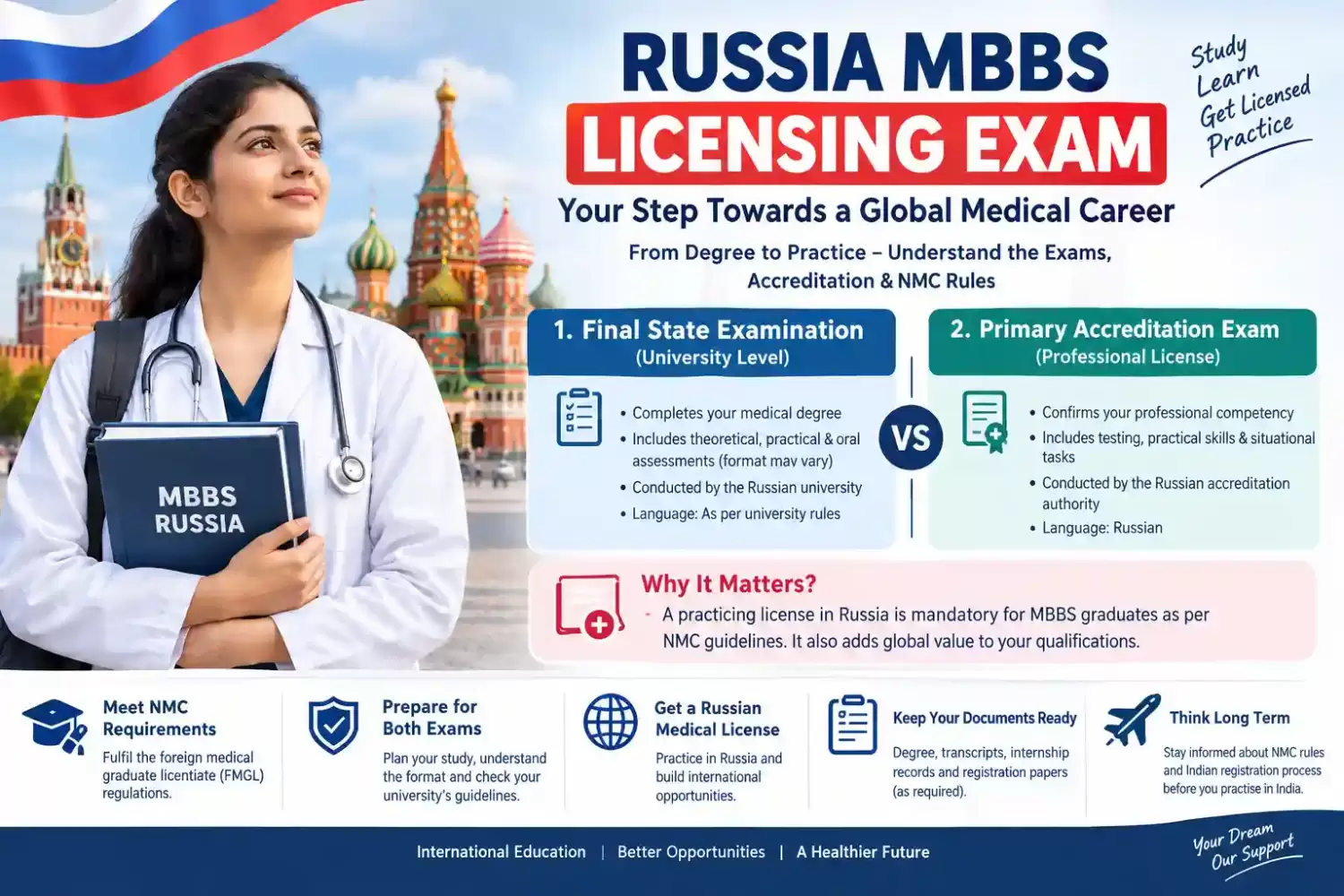
According to the applicable guidelines of the National Medical Commission (NMC) of India, Indian students pursuing medical education abroad must fulfil the relevant requirements for foreign medical graduates before they can obtain registration to practise medicine in India. For students completing their medical degree in Russia, understanding the country's professional accreditation system is an important part of planning their medical career.
The Russian system distinguishes between the final examinations required to complete a medical degree and the professional accreditation process for eligible medical graduates. Students should understand both processes and verify the requirements applicable to their university and graduation year.
Understanding the Difference: GOZZ Exam vs. Akkredition Exam
Key Distinction:
- GOZZ Exam evaluates academic knowledge and practical skills as part of the MBBS/MD degree requirements.
- Akkredition Exam certifies eligibility to practice as a licensed doctor in Russia and fulfills the NMC’s licensing mandate.
|
Aspect |
GOZZ Exam |
Akkredition Exam |
|
Purpose |
Final examination for obtaining the MBBS/MD degree. |
Licensing exam for obtaining a practice license in Russia. |
|
Language |
Conducted in English. |
Conducted in Russian. |
|
Timing |
Taken in the final year of the MBBS/MD course. |
Taken after the GOZZ exam and receiving the degree. |
|
Structure |
– MCQ Test – Practical Examination – Oral Viva |
MCQ-based exam only. |
|
Difficulty Level |
Comprehensive and rigorous, assessing theoretical and practical knowledge accumulated over 6 years. |
Comparatively easier, focused on accreditation. |
|
Significance |
Essential for earning the MBBS/MD degree. |
Essential for obtaining a license to practice medicine in Russia. |
|
Validity |
Not applicable (degree is permanent). |
License is valid for 5 years and requires renewal. |
|
Conducting Authority |
Conducted by the respective Russian medical university. |
Conducted by the Public Registration Authority of Health Practitioners in Russia. |
|
Requirement by NMC |
NMC mandates acquiring a practice license, making this exam mandatory for Indian students. |
Fulfills the NMC’s requirement of obtaining a license in the country of study. |
Final State Examination: Completing the Medical Degree
The final state examination is an important stage in completing a medical degree in Russia. It assesses the knowledge and skills students acquire during their medical education.
The examination arrangements may differ according to the university, approved curriculum and applicable educational requirements.
Structure of the Final Examination
Depending on the programme and university regulations, final assessments may involve the following elements:
-
Theoretical Assessment
-
Questions covering relevant medical subjects.
-
Assessment of knowledge in clinical and preclinical disciplines.
-
Evaluation of the student's understanding of diagnosis and treatment.
-
-
Practical or Clinical Assessment
-
Evaluation of clinical reasoning and practical competencies.
-
Interpretation of relevant clinical findings.
-
Demonstration of appropriate approaches to patient assessment and management, where required by the examination format.
-
-
Oral Examination
-
Questions relating to diseases, diagnosis, investigations and treatment.
-
Assessment of the student's ability to explain clinical decisions.
-
Discussion of medical cases relevant to the programme.
-
The precise format, passing criteria and assessment stages should be obtained from the student's university rather than assumed to be identical across all Russian medical institutions.
Significance of the Final State Examination
Successful completion of the required final assessments is part of fulfilling the university's requirements for the award of the medical degree.
Students should remember that graduation and professional accreditation are separate matters. Completing the academic programme does not automatically establish that every requirement for professional practice in Russia or India has been fulfilled.
Difficulty Level
The final examination assesses knowledge developed throughout medical school. Students should prepare consistently in theoretical subjects, clinical disciplines and practical training.
The level of difficulty and assessment method depend on the university's examination rules and the requirements applicable to the graduating class.
Syllabus of the Final Examination
The examination content is determined by the approved curriculum and applicable university regulations. It may cover preclinical, paraclinical and clinical disciplines studied during the medical programme.
Students should obtain the official examination syllabus and preparation guidance from their university.
Akkredition Licensing Exam: The Path to Practice
After successfully passing the GOZZ Exam, students must take the Akkreditation Licensing Exam, a vital step to practice medicine in Russia.
Key Features of the Akkredition Exam
- Format: MCQ-based examination.
- Validity: The license obtained is valid for five years.
- Ease of Clearing: Students who pass the GOZZ Exam typically find this exam manageable.
Procedure
- Students can appear for the Akkredition Exam 1-2 weeks after receiving their MD degree.
- The Akkredition Exam is conducted in Russian Language.
- Results are generally declared within a month, and the licensing documentation is completed in 30-40 days.
- Upon passing, students are entitled to practice as MD doctors in Russia.
Significance of Licensing
- A practicing license in Russia is mandatory for MBBS graduates who wish to continue their medical careers in the country.
- It is also a valuable credential for Indian students, enhancing their resumes and offering the flexibility to practice in both Russia and India (after clearing NEXT or FMGE).
Importance of Licensing as per NMC Gazette
The NMC mandates acquiring a practicing license from the country of study as a prerequisite for medical graduates returning to India. This ensures the graduates meet international and national standards of medical education.
General Notes for Indian Aspirants
- The licensing process involves clearing an accreditation examination conducted in Russian, which tests the student’s competency to practice medicine in Russia.
- For Indian students, obtaining this license not only fulfills NMC requirements but also opens doors to practice in Russia and adds global recognition to their qualifications.
Aspirants Should Consider:
- Preparing thoroughly for both the GOZZ and Akkreditation exams, as these are pivotal for their medical careers.
- Embracing this process as an opportunity to gain dual recognition, enabling practice in both India and Russia.
By adhering to these steps, medical graduates can ensure compliance with NMC regulations and secure a promising future in medicine.
Importance of Russian Accreditation Under NMC Regulations
The National Medical Commission's Foreign Medical Graduate Licentiate (FMGL) Regulations, 2021, include requirements concerning the registration of foreign medical graduates with the competent professional regulatory body or authority in the country where their medical degree is awarded.
For graduates covered by these regulations, Regulation 4 addresses the requirement for registration with the relevant authority competent to grant permission to practise medicine, on terms at par with those applicable to citizens of that country.
However, students should not assume that passing an examination described as the “GOZZ Exam” is itself an NMC requirement. Nor does a Russian accreditation document alone guarantee eligibility for Indian registration.
The rules applicable to an individual student depend on the relevant regulatory provisions and admission circumstances. Students should verify their requirements with the NMC and the appropriate Indian registration authority.
Important NMC Requirements for Indian Students
For students covered by the FMGL Regulations, 2021, the requirements include:
-
A foreign medical degree course with a minimum duration of 54 months.
-
A minimum 12-month internship in the same foreign medical institution.
-
English as the medium of instruction for the foreign medical degree.
-
Study of the mandatory subjects specified in Schedule I.
-
Registration with the competent authority in the country where the degree is awarded, as required by the regulations.
-
A supervised internship in India for a minimum of 12 months, subject to the applicable rules.
-
Passing the National Exit Test or another examination mandated by the Commission.
Schedule I also addresses clinical training, the location of the course and internship, and completion of the foreign medical graduation course within ten years from the date of joining.
Important: The ten-year provision is a maximum completion period; it does not mean that the MBBS course itself must last ten years.
Regulation 5 also contains provisions concerning applicability. Students who began their studies before the regulations came into force may be governed by the earlier applicable regulations. Students should verify the rules relevant to their admission date and circumstances.
General Notes for Indian MBBS Aspirants
Before enrolling in a Russian medical university, students should carefully review the academic and professional requirements associated with the programme.
-
Confirm the official name and format of the final state examination.
-
Understand the primary accreditation process applicable to the medical qualification.
-
Prepare for the Russian-language requirements associated with professional accreditation.
-
Obtain written information about the course duration and internship arrangements.
-
Keep academic transcripts, clinical training records and internship certificates.
-
Verify the foreign-country registration requirements applicable under NMC regulations.
-
Check the current Indian examination and registration pathway before planning to practise in India.
Frequently Asked Questions
1. Is the GOZZ Exam compulsory for Indian students studying MBBS in Russia?
Students must complete the examinations required by their university and degree programme. Because “GOZZ Exam” may be an informal or inconsistent term, students should confirm the official examination name and requirements with their university.
2. Is primary accreditation different from the final medical examination?
Yes. The final state examination relates to completion of the degree programme, while primary accreditation is part of Russia's professional accreditation system.
3. Is primary accreditation conducted in English?
Russian is prescribed for primary accreditation. International students should prepare for the relevant language requirements and confirm current examination instructions with the competent authority.
4. Is primary accreditation an MCQ-only examination?
The general primary accreditation process includes testing, practical skills assessment and situational tasks. It should not be described as an MCQ-only examination.
5. Does Russian accreditation automatically allow a graduate to practise in India?
No. Graduates must satisfy the Indian medical registration requirements applicable to them, including the relevant examination, internship and registration conditions.
6. Does every Indian student need a Russian professional registration document?
Students covered by the applicable FMGL provisions must consider the foreign-country registration requirement. The exact documentation and process should be confirmed with the competent Russian authority and the NMC.
7. Does a six-year MBBS programme automatically satisfy NMC requirements?
No. Duration alone is insufficient. The degree, medium of instruction, curriculum, clinical training, internship and foreign-country registration must be assessed against the applicable regulations.
Conclusion
Medical education in Russia involves both academic requirements and, where applicable, professional accredita