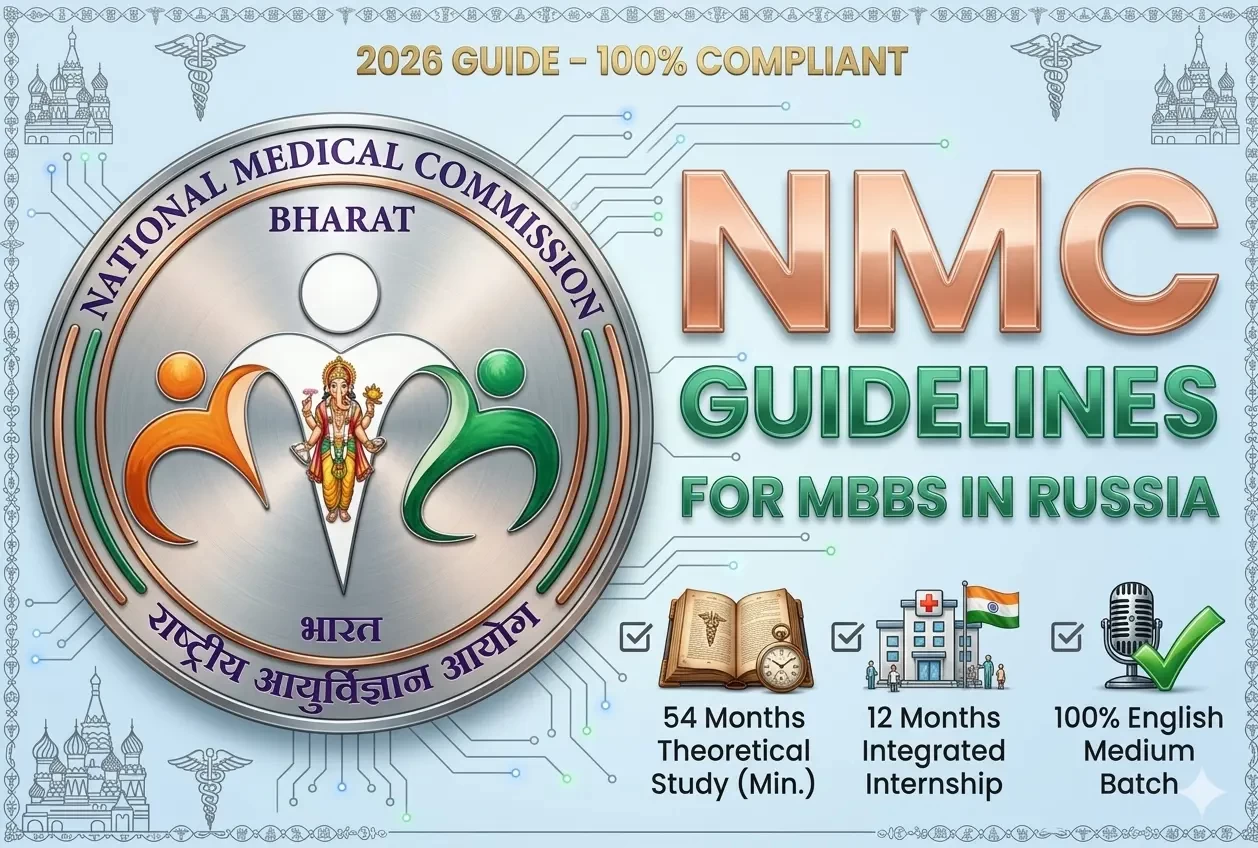
To legally practice medicine in India after studying abroad, the National Medical Commission (NMC) mandates that Indian students must be fully registered and licensed to practice in the country where they earned their degree. For international graduates in Russia, this requires clearing the Russian Primary Medical Accreditation Exam (Первичная аккредитация).
Passing this centralized exam—conducted shortly after graduation—gives you an official license to practice as a General Practitioner (GP) in Russia. It also satisfies the NMC regulations needed to sit for India's FMGE or NExT exams.
📋 Exam Pattern & Structural Layout
The licensing exam is handled directly by the Ministry of Health of the Russian Federation (not individual universities). It is completed over 2 to 3 days and consists of three consecutive, elimination-style stages.
[STAGE 1: Computer MCQ Test]
• 60 randomly selected questions | 60 minutes
• Must score ≥ 70% to advance
│
▼
[STAGE 2: Objective Structured Clinical Exam (OSCE)]
• Hands-on practical stations in a simulation center
• Narrative actions must be spoken aloud in Russian
│
▼
[STAGE 3: Situational Case Reasoning]
• Oral defense of complex clinical patient charts
• Handled completely via a panel interview in Russian
📚 Detailed Syllabus Breakdown
The syllabus spans the complete 6-year General Medicine curriculum. Rather than abstract theory, it targets clinical judgment and immediate patient safety across these key disciplines:
- Internal Medicine: Cardiology (interpreting ECGs), Pulmonology, Gastroenterology, Nephrology, and handling acute medical emergencies.
- Surgical Disciplines: General Surgery, Traumatology, triage management, sterile field preparation, and surgical instrumentation.
- Maternal & Child Health: Routine Obstetrics, common Gynecological emergency protocols, and baseline Pediatrics.
- Hygiene, Public Health, & Law: Infectious disease containment, epidemiological protocols, and Russian healthcare frameworks.
- Basic Life Support (BLS): Cardiopulmonary Resuscitation (CPR), airway management, and choking emergencies. [4, 9, 10]
🎯 The Real Difficulty Scale for Indian Students
The actual medical difficulty of the exam is moderate, but it presents unique challenges for Indian students due to linguistic and technical barriers:
1. The Language Barrier (High Difficulty)
While your 6-year MBBS lectures, textbooks, and internal university assessments are fully English-medium, the national licensing exam is conducted strictly and completely in the Russian language.
- MCQs (Stage 1): You must be able to read complex Russian medical terms quickly.
- OSCE & Viva (Stages 2 & 3): You must speak fluently and interact with a panel of local doctors using accurate Russian medical syntax. If your conversational language skills are weak, this stage becomes exceptionally difficult.
2. Strict Automated Testing
The computer MCQ test (Stage 1) selects 60 random questions from a massive, centralized government question bank. Because the passing mark is set high at 70% (at least 42 correct answers out of 60), there is no room for guesswork.
3. Practical OSCE Rigour
The simulation labs utilize high-fidelity electronic mannequins and sensors that track your movements in real time. If you position a syringe incorrectly, perform shallow chest compressions, or miss a step in sterile protocol, the sensor registers an automatic fail for that station.
💡 Key Strategy Tips for Success
- Learn Russian Professionally: Do not treat your early-year Russian classes as minor subjects. Aim for solid B2-level language proficiency by Year 4 so you can communicate effortlessly with real hospital patients and prepare for the final oral exam. [
- Utilize the FMZA Practice Portals: The Russian Ministry of Health hosts public mock portals (such as the FMZA platform). This site allows students to practice the exact database of thousands of translation questions well ahead of the final exam.
- Max Out Hands-On Simulation Hours: Spend extra time in your university’s simulation hub starting in Year 4. Memorizing the physical motions and verbal Russian descriptions for every OSCE station removes exam-day anxiety.