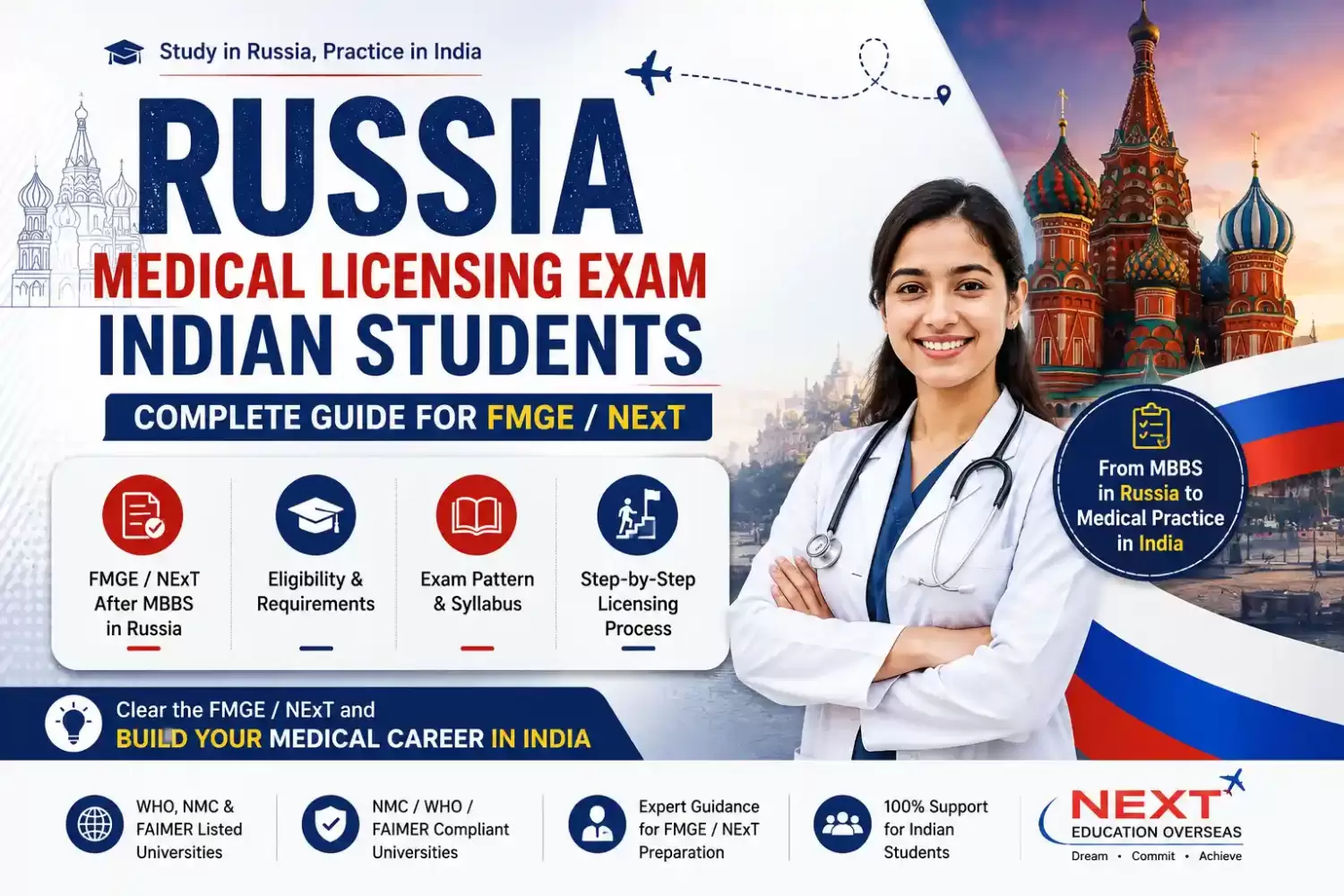
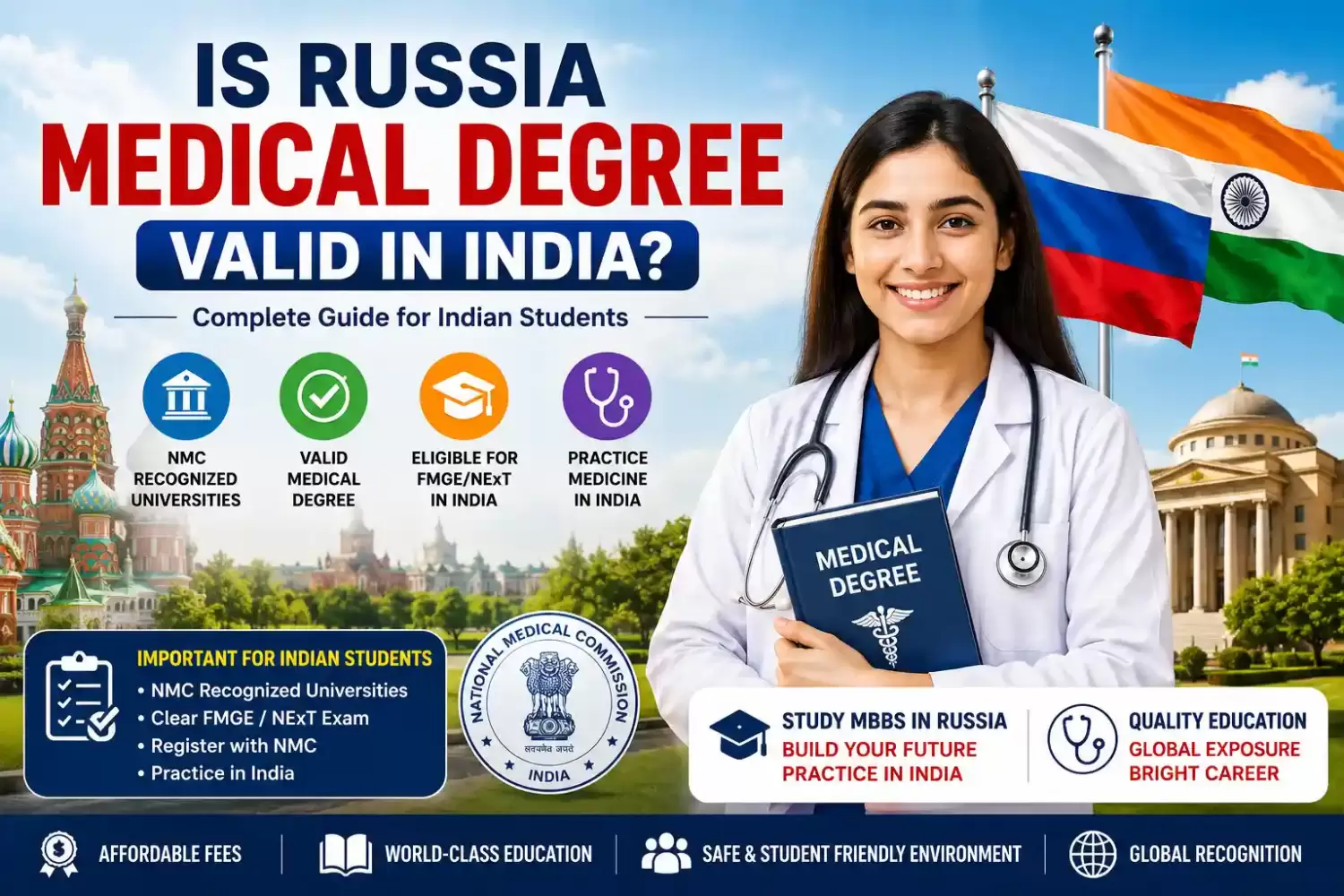
RUSSIA MBBS DEGREE VALID IN INDIA
Introduction
Russia is one of the most popular destinations for Indian students pursuing MBBS abroad because of its affordable tuition fees, experienced faculty, modern medical infrastructure, and globally recognized universities. However, one of the most common questions students and parents ask is:
"Is a Russia medical degree valid in India?"
The answer depends on whether the student completes their medical education in accordance with the applicable regulations of the National Medical Commission (NMC) and fulfills the required licensing requirements in India. Simply obtaining an MBBS degree from a foreign university does not automatically grant the right to practice medicine in India.
This guide explains the validity of a Russia medical degree in India, important NMC regulations, eligibility requirements, licensing process, and key factors students should consider before taking admission.
Is a Russia Medical Degree Valid in India?
Yes, a medical degree from Russia may be recognized for Indian students if the student studies at an appropriate university and fulfills the applicable NMC regulations and licensing requirements in India.
Students planning to return to India should always verify:
- Eligibility requirements
- University recognition
- Course duration
- Internship requirements
- Applicable NMC regulations
- Medical licensing requirements
Choosing the right university is one of the most important decisions for a successful medical career.
NMC Regulations for Indian Students
Students planning to practice medicine in India after completing MBBS abroad should carefully understand the latest applicable NMC regulations.
Students should ensure:
- They meet the required eligibility conditions.
- They choose a university that follows the applicable standards.
- Their medical education complies with the relevant regulations.
- They fulfill the licensing requirements before practicing in India.
Before admission, always refer to the latest official NMC guidelines, as regulations may change over time.
Medical Licensing Requirements in India
After completing a medical degree abroad, students must follow the applicable medical licensing process in India.
The licensing pathway depends on the regulations in force at the time of graduation.
Students should stay updated with official notifications issued by the concerned authorities regarding eligibility, examinations, internship, and registration requirements.
The NMC governs recognition of foreign medical qualifications in India. Key points:
-
The NMC website explicitly states that it does not maintain or endorse any list of foreign medical institutions/universities for MBBS or equivalent courses. Instead, it emphasises that Indian students should check independently about the course, duration, internship, medium of instruction, etc.
-
For any person (Indian citizen or OCI) who obtains a primary medical qualification from outside India and wants registration (provisional or permanent) with NMC or any State Medical Council, they must qualify a screening test.
-
The “Foreign Medical Graduate Licentiate” (FMGL) type regulations (e.g., the 2021 Gazette) set out specific criteria.
So from a regulatory viewpoint: simply getting a medical degree abroad does not automatically mean you can practise in India. Several criteria must be met, and clearing the screening/licensing step is essential.
2. What Are the Conditions That a Foreign Medical Degree Must Meet?
According to NMC‐guidelines and notices, key requirements include:
a) Duration, Structure & Internship
-
The foreign medical degree must be at least 54 months (4.5 years) of academic study followed by a 12 months internship/clinical training in the same foreign institution.
-
All training (academic + internship) must be done outside India, i.e., the same foreign medical institution throughout the course; no part of training or internship in India or any other country.
-
The internship component must be in the country of the institution awarding the primary medical qualification.
b) Medium of Instruction & Curriculum
-
The program must be taught in English (for students intending to return and practise in India).
-
The curriculum must include key subjects: community medicine, general medicine, psychiatry, paediatrics, surgery, anaesthesiology, obstetrics & gynaecology, orthopaedics, ophthalmology, ENT, dermatology, emergency/casualty, lab services etc. The syllabus must be equivalent to the MBBS course in India.
-
Recognition of the Institution & Degree
-
The institution should be recognised by its home country’s relevant authority (medical council/health ministry).
-
The degree must qualify the holder to enrol as a medical practitioner in that country (i.e., licensable there) — this helps with Indian registration. (NMC guidelines mention that the primary medical qualification must be one which is a recognised qualification for enrolment as a medical practitioner in the country where the institution is.)
-
While the NMC does not publish a list of approved foreign universities, students are advised to verify details such as listing in the World Directory of Medical Schools (WDOMS).
d) Screening/Registration After Return to India
-
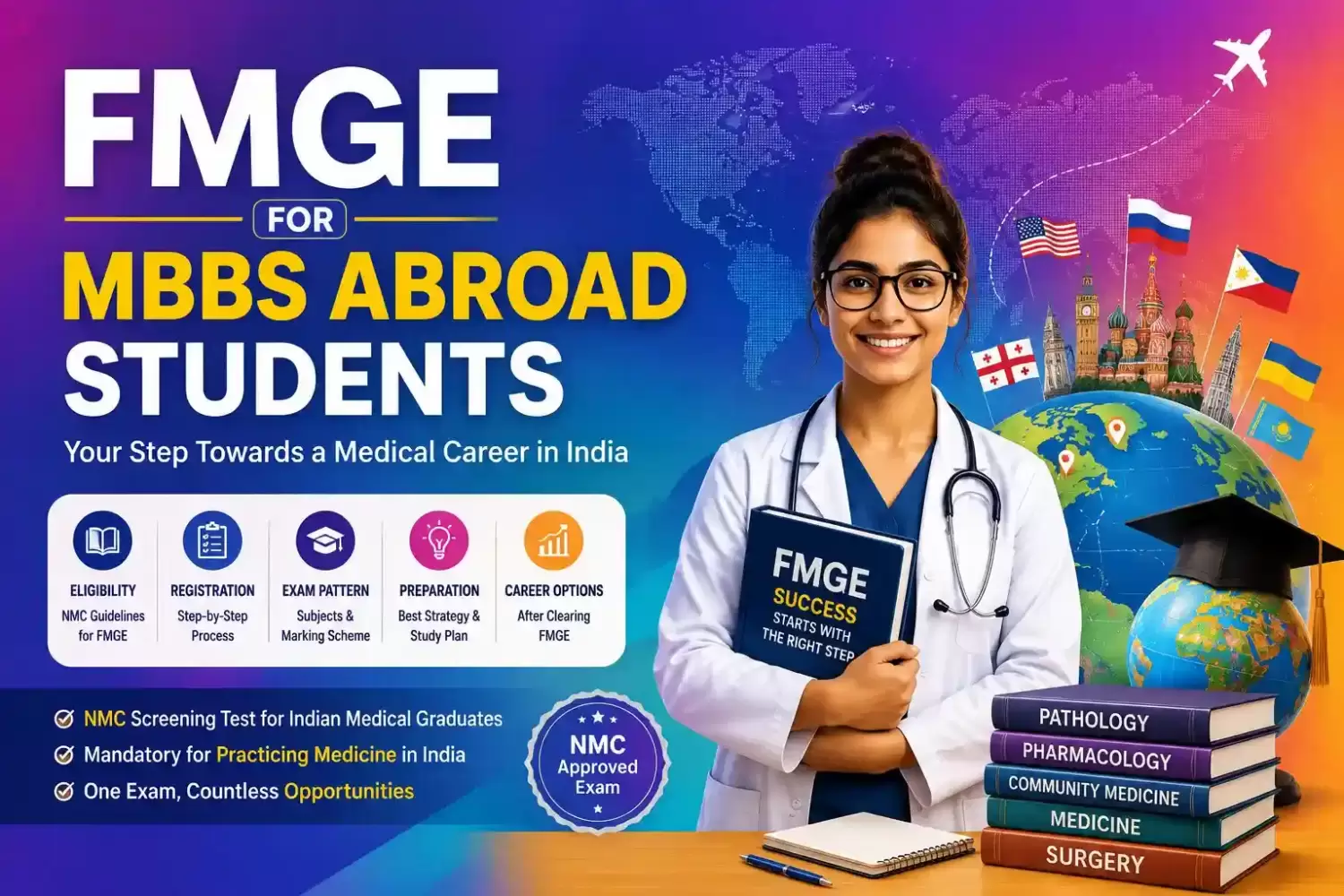
Upon return to India, the graduate must pass the foreign medical graduate screening test (currently the Foreign Medical Graduate Examination (FMGE) or whichever exam is in force (like the proposed NExT).
-
After passing, one may apply for registration with a State Medical Council and then practise in India.
e) Time‐Limit
-
One of the guidelines states the total foreign medical course + internship must be completed within 10 years from the date of joining.
4. Practical Steps & Recommendations for Indian Students Considering Russia
Here are actionable steps to reduce risks and ensure better chances of recognition:
-
Verify the Russian University:
-
Check if the university is listed in WDOMS (World Directory of Medical Schools) or has an equivalent listing.
-
Check if the medical degree awarded is recognised by the Russian health/medical authority and leads to licensure in Russia.
-
-
Check the Course Details Carefully:
-
Duration: Minimum 4.5 years of academic + 1 year internship (12 months).
-
Ensure the internship is full-time, 12 months, at the same institution and country.
-
Ensure the curriculum matches MBBS in India (includes the subjects stipulated by NMC).
-
Medium: Entirely in English (no requirement to switch to Russian for major parts).
-
-
Before Admission: Secure Information in Writing:
-
Admission letter, curriculum, internship details, medium of instruction, cost, hostel/accommodation details.
-
Ask for official documentation of recognition/licensure of the degree in Russia.
-
-
Keep Documentation & Eligibility Certificate:
-
The student should obtain from NMC a certificate of eligibility or verify eligibility to appear for FMGE. The NMC website emphasises that students should verify eligibility before admission abroad. NMC
-
Maintain transcripts, letter from university about internship, certificate of completion.
-
-
Prepare for Screening Test (FMGE / NEXT):
-
After finishing abroad, plan to return and clear the screening/licensing exam in India.
-
Some students also prepare for additional internship or supervised training in India if required by State Medical Council.
-
-
Be Aware of Changing Regulations:
-
The draft rule reported by Mint (July 2025) mentions that the NMC may charge foreign institutions/diplomas $10,000 for recognition of foreign medical courses.
-
Stay updated with NMC notifications—especially for foreign medical graduates (FMGs).
-
Conclusion
A Russia medical degree can open excellent opportunities for Indian students when the right university is selected and the applicable regulations are followed. Before taking admission, students should carefully evaluate university quality, eligibility requirements, licensing pathways, and current NMC guidelines.
Proper planning, choosing a suitable university, and staying informed about official regulations can help students build a successful medical career.
Frequently Asked Questions (FAQs)
1. Is a Russia medical degree valid in India?
A Russia medical degree may be recognized if students complete their education according to the applicable regulations and fulfill the required licensing requirements in India.
2. Can Indian students practice in India after MBBS from Russia?
Students must complete the applicable licensing process and meet the regulatory requirements before practicing medicine in India.
3. How can I check whether a Russian medical university is suitable?
Students should verify university recognition, course structure, academic quality, and applicable eligibility requirements before admission.
4. Does every Russian medical university have the same recognition?
Students should individually verify the status of the university and ensure it meets the applicable requirements before taking admission.
5. What should students consider before choosing MBBS in Russia?
Students should compare university quality, tuition fees, living expenses, eligibility requirements, and official regulations before making a final decision.